
In the luxury market, price differences often hide in the details.
By KÉSH TEAM
Written by / KÉSH Luxury Authentication Team
Browsing the pre-owned luxury market, a quiet question often surfaces.
The same Hermès Lindy, the same Chanel Classic Flap—even the same year and colour—yet prices can diverge by tens of thousands, sometimes hundreds of thousands.
For buyers new to pre-owned luxury, the first reaction is usually confusion.
They all look beautiful. Why is the gap so wide?
The answer usually lives in two words: condition.
Those letters—S, SA, A, AB, B—that appear again and again on product pages are the shared language of the international luxury resale market for describing a piece's state.
Seasoned collectors, however, rarely judge value by letters alone.
In today's thriving secondary market, how new or worn a piece is matters—but it has never been the only measure.
Learning condition grades is not about chasing perfection. It is about reading a piece's present state more accurately—and the market value that state implies.
Why Does the Luxury Market Need Condition Grades?
If you have ever bought art, vintage watches, or classic cars, you already know this.
A mature collecting market needs an evaluation language both buyers and sellers can share.
Luxury is no different.
Every piece has a different history of use, storage, and year of purchase. Without a common standard, it is hard to judge condition quickly online.
So the market gradually settled on an internationally recognised grading system.
Regions, auction houses, and platforms may vary slightly in their criteria, but the core idea is the same: grades help buyers form a clear first impression of a piece's state.
Importantly, a condition grade is not a verdict on authenticity—nor the sole basis of price.
It is simply one way of describing how a piece presents today.
Luxury Condition Grade Chart
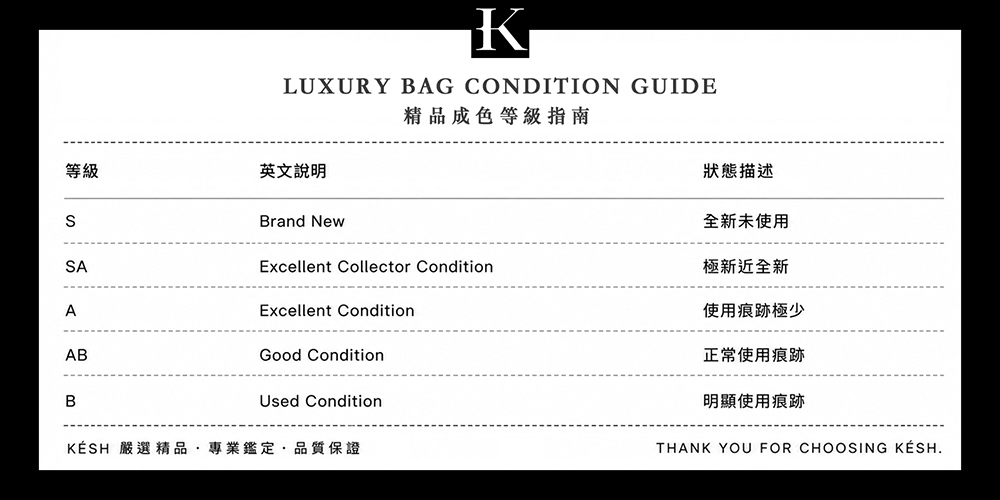
S Grade|Brand New
S grade usually means the piece is as close as possible to boutique-new.
In most cases it has never been properly used; some pieces still carry the original protective film, purchase proof, and a full set of accessories.
Many collectors store acquisitions immediately in humidity-controlled cabinets—so even after years, the look remains near-new.
One nuance is easy to overlook.
Luxury is not mass industrial production.
Even unused pieces may show the faintest marks from storage, display, or the nature of the leather itself.
In collecting, "brand new" usually means a state close to what the maison delivered—not absolute zero imperfection.
For buyers who prize collectible value, gifting, or a near-new presence, S grade remains one of the most sought-after tiers.
SA Grade|Excellent Collector Condition
If S grade is the collector's ideal, SA is often what seasoned buyers love most.
These pieces may have been briefly used, tried on, or picked up the lightest marks from storage.
Overall condition, however, stays exceptionally high.
From a normal viewing distance, noticeable wear is usually hard to find.
Many recent Hermès, Chanel, or Dior favourites fall into this range.
In a sense, SA offers a compelling balance.
It keeps a near-new presence while often commanding a more considered market price than brand-new stock.
That is why SA is often seen as the sweet spot of both collecting and everyday wear.
A Grade|Excellent Condition
A grade is the most common tier in pre-owned luxury—and the most misunderstood.
Many hear "pre-owned" and assume the piece is compromised.
In truth, most A grade pieces still present beautifully and wear well.
They have usually seen normal use, yet the structure remains sound.
You may find light corner wear, soft leather creases, hairline marks on hardware, or interior use.
These are largely the natural traces of a luxury piece living its life.
For buyers balancing budget and presence, A is often one of the market's most attractive ranges.
Even after years of use, popular bags kept with care can still hold an excellent overall state.
AB Grade|Good Condition
AB grade means a piece has seen longer everyday use.
Compared with A, signs of wear are more visible.
For example:
- Corner wear
- Hardware use
- Leather creasing
- Handle softening
- Interior wear

Yet AB does not mean the piece is in poor shape.
On the international market, many rare colours, discontinued models, or sought-after sizes
still command strong demand even at AB.
For true collectors, scarcity can matter more than how new a piece looks.
Some classics that are hard to find again remain coveted even with the marks of time.
B Grade|Used Condition
B grade pieces usually show clearer wear and a stronger sense of age.
They may include:
- Visible corner wear
- Leather use marks
- Hardware fading
- Interior softening
- The natural traces of long ownership
For some buyers, this state may fall short of expectations.
In collecting, nothing is quite so absolute.
Many Vintage Chanel and Vintage Hermès pieces gain character precisely from those marks of time.
Fine wear and use become a record of the years a piece has lived—and part of its story.
What Collectors Really Look At Is More Than Condition
For newcomers, condition is the easiest metric to grasp.
Seasoned collectors weigh far more when assessing value.
For example:
- Whether the size is sought after
- Whether the colour is classic
- Whether accessories are complete
- Whether the model is discontinued
- Whether it carries a special year or stamp
- Whether market supply is scarce
That is why an A grade Mini Kelly can still outvalue an S grade piece of limited demand.
Likewise, a Vintage Chanel marked by time may draw collectors more than a recent release.
The luxury market has never been a simple contest of new versus old.
What shapes value is scarcity, desire, and the story time has written.
Condition Is Not a Score—It Is a Way of Understanding Luxury
Many people, meeting pre-owned luxury for the first time, hope for a perfect dream bag.
The deeper you go, the clearer this becomes.
Luxury was never made to sit untouched in a display case.
It was designed to accompany life, mark the years, and witness different chapters of a life.
So condition grades were never meant to declare a piece good or bad.
They are a shared language.
They help us see how much time a piece has lived, what marks it carries, and where it stands today.
Some prefer near-new collectibles.
Others are drawn to classics softened by time.
What matters was never the letter itself.
It is whether, the moment you see it, you still want it to walk with the life ahead.